
Key takeaways:
-
MRI scans use magnetic fields and radio waves to create detailed images of the inside of the body.
-
An MRI scan of the leg is a non-invasive procedure that shows the bones, muscles, soft tissue, blood vessels and nerves of the upper and lower leg
-
Doctors use the images from a leg MRI scan to diagnose and rule out a range of conditions affecting the leg, including muscle tears, bone fractures, soft tissue injuries and inflammation
-
Some leg MRI scans require the use of a contrast dye injected into a vein, and apart from some mild discomfort as the dye is injected, you won't feel anything during an MRI scan
What is a Leg MRI?
MRI stands for magnetic resonance imaging, and a leg MRI is used to take detailed images of the bones (including the tibia and fibula), soft tissues (including the cartilage, ligaments and tendons), muscles, nerves and blood vessels of the leg, and if necessary, the ankle and knee joints. MRI scans are non-invasive procedures, and you’ll be able to return home the same day.
Types of Leg MRI
There are various types of leg MRI scans; which one you have will depend on your symptoms, medical history and current level of health.
- T1-Weighted MRI - Used to show the anatomy of the inside of the leg, including the location of the bones, muscles and fat, including any abnormalities.
- T2-Weighted MRI - Helpful for highlighting areas of fluid, indicating swelling and inflammation.
- Proton Density MRI - Shows the cartilage and tendons in more detail.
- STIR MRI (Short Tau Inversion Recovery) - Used to highlight fluid and swelling around metal prostheses.
- Fat-Suppressed MRI - Images exclude areas of fat, helping to highlight fluid and swelling in the bones and joints.
- Contrast-Enhanced MRI - A standard leg MRI with a contrast dye injection to help better highlight the blood vessels and soft tissues.
- Diffusion-Weighted Imaging - Assesses the movement of water molecules to assess muscle and tendon tears, inflammation and infection.
- MR Angiography - Used to create images of the blood vessels of the legs to assess for narrowing and blockages.
Reasons for a Leg MRI
If you’re experiencing any of the following symptoms, you may benefit from a leg MRI to help your doctor understand what’s causing your symptoms and recommend treatments:
-
Leg pain due to injury
-
Unexplained leg pain, such as shooting pains or pain that doesn’t improve with rest
-
Swelling, redness and inflammation
-
Stiffness, immobility and difficulty walking
-
Problems balancing or standing
-
Reduced range of motion, meaning that bending, straightening or twisting is difficult
-
Leg instability
-
Popping, crunching or grinding in the ankle or knee joint
-
Numbness or tingling
-
A mass or lump
Depending on your symptoms, your doctor may decide to perform an MRI scan of the whole leg, ot just the upper or lower leg.
What a Leg MRI Can Diagnose
An MRI of the upper and lower leg is used by doctors to diagnose and rule out a range of conditions and diseases, including:
-
Muscle Tears - tears to the muscles caused by accident or injury
-
Ligament Injuries - damage to the ligaments, the soft tissues that connect bones to bones
-
Tendon Injuries - damage to the tendons, the soft tissues that connect muscles to bones
-
Stress Fractures - bone fractures caused by repeated motion over time
-
Bone Tumours - malignant (cancerous) or benign (non-cancerous) lumps growing on or in the leg bones
-
Soft Tissue Tumours - malignant (cancerous) or benign (non-cancerous) lumps growing on or in the soft tissues of the leg
-
Infections - bacterial and viral infections affecting the bones and soft tissues
-
Vascular Conditions - conditions affecting the major or minor blood vessels of the leg
How a Leg MRI Works
MRI scanners use magnetic fields and radio waves to create detailed images of the inside of the body. During an MRI scan, the hydrogen atoms that make up the different body parts become temporarily disrupted. As they’re disrupted, the hydrogen atoms create energy that’s picked up by the MRI scanner.
This energy is then turned into images by MRI computers. Each type of tissue, from the blood vessels, nerves and soft tissue (including the tendons, ligaments and cartilage) to the organs, muscles and bones, creates a different type of energy and therefore appears differently on MRI images.
A doctor called a radiologist is trained to understand these differences, and can determine healthy tissues from tissues affected by disease and abnormalities.
Benefits
MRI scans are considered safe for most people and are a quick, effective way of producing detailed images of the inside of your body. They’re generally considered safe for pregnant women, but tend not to be carried out in the first trimester.
Unlike CT scans and x-rays, MRI scans don’t use ionising radiation and therefore don't carry the same, albeit small, risks of radiation exposure from repeated scans.
Risks & Side Effects
There are no known side effects to having a leg MRI scan, and the risks are minimal.
Some leg MRI scans require the use of a contrast dye injected into a vein, usually in the arm, that helps to highlight the blood vessels and soft tissues. Contrast dyes contain a substance called gadolinium, which some people are allergic to, without knowing about it. This can be especially problematic if you have kidney problems.
You’ll be monitored for signs of an allergic reaction, and the symptoms include feeling flushed, breathless and excessively sweaty. Let your healthcare professional know if you start to feel unwell after having a contrast dye injection.
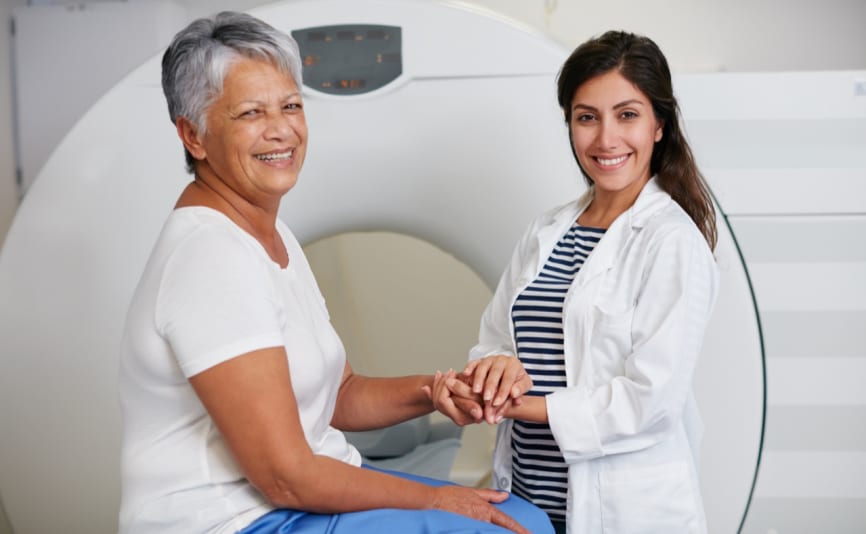
An MRI scanner is a round, doughnut-shaped device. Patients lie on a table that slowly moves into the machine, and during the scan, as powerful magnets are turned on and off, you’ll hear a loud knocking noise. Some patients find this enclosed space uncomfortable, especially those with claustrophobia.
Your doctor may be able to prescribe a mild sedative that can help. However, most leg MRI scans only require the bottom half of the body to enter the scanner, meaning that the head and upper body remain outside.
How to Prepare for a Leg MRI
MRI scans of the leg require very little preparation. Unless otherwise instructed by your doctor or medical professional, you can eat, drink and take medications as normal before your scan appointment.
However, metal objects cannot be taken into an MRI scanner or the room housing the machine, as magnetic metals are attracted to the magnetic field. You’ll be provided with a safe place to leave any jewellery, watches, hair clips, mobile phones, bank cards, cash and any other metal objects, and given a hospital gown to change into.
If you have any removable medical devices, such as hearing aids or dentures that contain metal, you should remove them before your scan.
Discuss any non-removable implants, such as cochlear implants, prostheses, surgical clips, meshes, valves or stents. Some newer devices are made from non-magnetic metal and may be safe in an MRI scanner. Bring any paperwork relating to your implants with you. If you’re not suitable for an MRI scan, your doctor may discuss alternative scans such as a CT scan or an x-ray.
The Procedure Explained: What to Expect
A leg MRI is conducted by a healthcare professional called a radiographer, and generally takes place in the following steps:
-
Safety Screening - Your radiographer will ask some questions about your symptoms, medical history and current health and wellbeing. They’ll also give you the chance to ask any questions about the procedure.
-
Changing into MRI-Safe Clothing - You’ll be asked to undress, and you’ll be given a hospital gown to change into to ensure you’re not wearing any clothing that contains metal.
-
Positioning on the MRI Table - Your radiographer will help you onto the MRI table. Most leg MRI scans require you to be lying flat on your back with your legs out flat and your feet facing the machine.
-
Leg Immobilisation - You’ll need to remain completely still throughout the scan, and a brace may be fitted over your leg to keep it still. You may also have a small device called a coil placed over the area of interest that helps create more detailed images.
-
Ear Protection Provided - Your radiographer will give you earplugs or headphones to help reduce the sound made by the MRI scanner.
-
Scanning Begins - They will then move to another room to operate the machine remotely. You’ll be able to communicate with them through an intercom.
-
Contrast Injection if Needed - If you’re having a contrast dye injection, it will be injected into a vein, usually in your arm, before the scan process starts again.
-
Completion of Scan - Once your radiographer is happy they have enough images, the scan will be complete, and you’ll be able to get up and get dressed. If you’ve had a contrast dye, you’ll be asked to remain in the clinic for half an hour so that you can be monitored for signs of an allergic reaction.
Getting the Results
After your MRI scan, you’ll be able to return home and to your normal duties the same day. Your scan will be reviewed by a doctor called a radiologist, and your results will take a few days. A member of the clinic team will be in touch to arrange a follow-up appointment to discuss your scan results and any further tests and treatment options.
What Does a Leg MRI Cost?
In the UK, a private MRI scan of the leg starts at around £250.
Get a Leg MRI
Leg pain, discomfort and immobility is frustrating and worrying, and can impact your day-to-day life and your enjoyment of sports and being active. Understanding what’s causing your symptoms can help you decide on the treatment that can help you get on with life again.
Jump the queues and waiting lists and book a private MRI scan of the leg with us. Choose from one of our UK-wide clinics at a time that suits you, with no need for a GP referral.
FAQs
Does Your Whole Body Go In for a Leg MRI?
No, generally you’ll enter an MRI scanner feet first for a leg MRI scan, with just your lower body entering the machine.
Can an MRI Show Nerve Damage in the Leg?
Yes, a leg MRI can show pinched, compressed or damaged leg nerves that might be causing pain, tingling, numbness, swelling or immobility.
How Long Does a Leg MRI Take?
A leg MRI takes between 30 and 60 minutes. If you’re having a contrast MRI scan, allow another 30 minutes for monitoring for signs of an allergic reaction.
What Does an MRI on the Leg Show?
A leg MRI shows abnormalities affecting the bones, muscles, ligaments, tendons, blood vessels and nerves of the leg, such as tumours, tears, fractures and inflammation.
Is a Leg MRI Painful?
No, an MRI scan is a non-invasive procedure, and you won’t feel anything during a leg MRI scan. However, if you’re having a contrast dye MRI, you may feel some discomfort as the dye is injected into a vein, usually in your arm.
Do I Need a Referral for a Leg MRI?
No, book your private MRI scan with us; you won’t need a GP referral or a letter from a medical professional, you can refer yourself.
References:
Website, N. (2025c, September 12). MRI scan. nhs.uk. https://www.nhs.uk/tests-and-treatments/mri-scan/
Leg MRI scan: MedlinePlus Medical Encyclopedia. (n.d.). https://medlineplus.gov/ency/article/007357.htm
Leg MRI scan. (2025, February 21). ucsfhealth.org. https://www.ucsfhealth.org/medical-tests/leg-mri-scan